 Ideal Fulfillment
What happens when a simple order suddenly becomes five products, a custom box, branded tissue, a promotional insert, a sample, and a launch date that cannot move?
For a growing ecommerce brand, that can turn packing into a much bigger job than expected. A few custom boxes may be easy for an internal team to assemble. Hundreds or thousands of them are another story. Packaging and Kitting Services can help businesses organize that complexity by bringing product assembly, custom packaging, inventory management, and fulfillment into a more structured process.
At Ideal Fulfillment, we see this challenge with subscription boxes, promotional bundles, gift sets, influencer packages, and new product launches. Each project may look different, but the goal is similar: the correct products need to be assembled consistently, presented properly, and ready to ship when customers expect them.
That is where professional packaging and kitting services can become an important part of the fulfillment process.
What Are Packaging and Kitting Services?
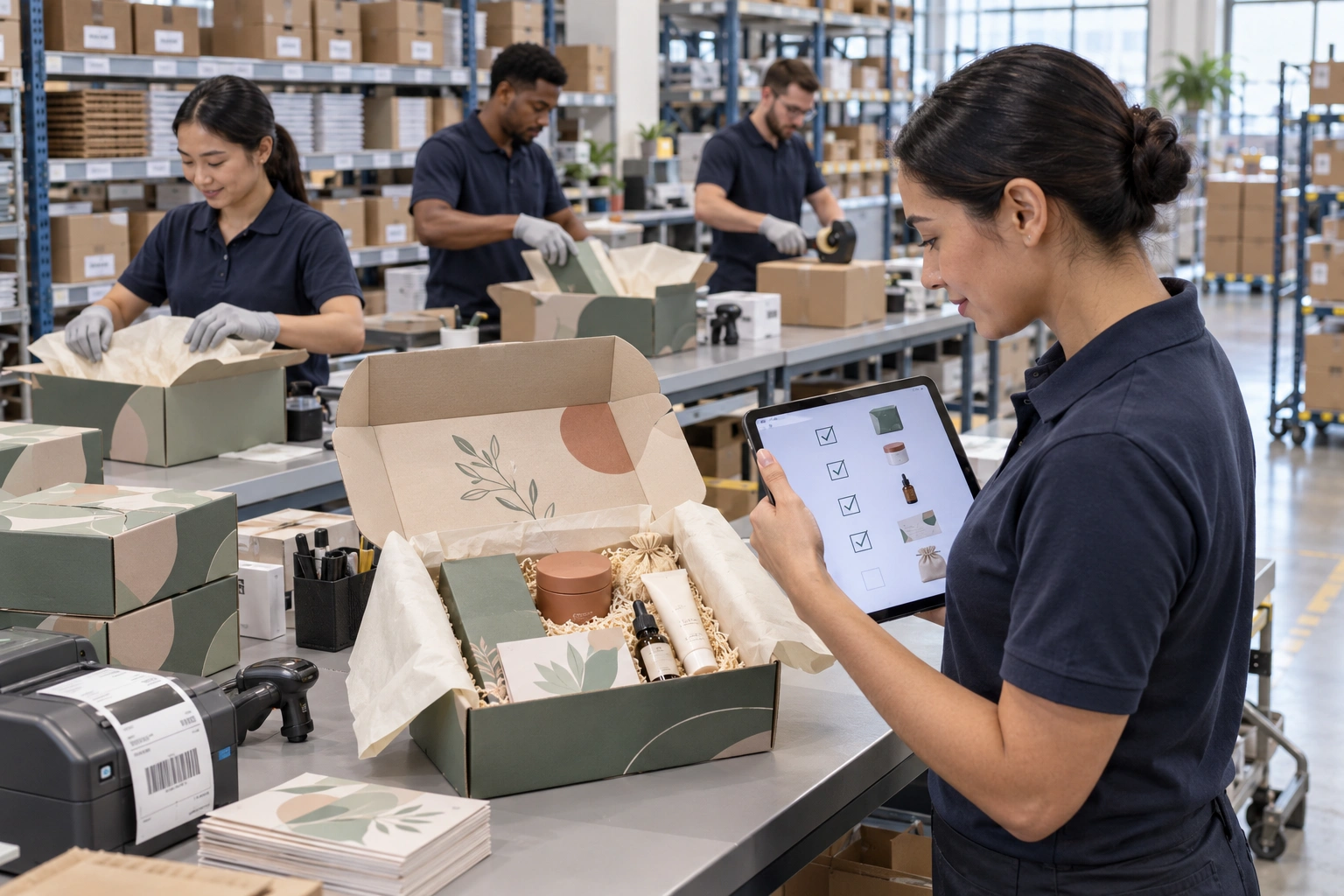
Packaging and Kitting Services combine individual products, components, and branded materials into a defined package that can be stored or prepared for shipment as a complete unit. Kitting may involve combining several SKUs into a subscription box, gift set, promotional bundle, influencer package, retail kit, or product launch package. The process can include sorting products, assembling boxes, adding samples, inserting printed materials, applying labels, arranging items in a specific order, adding protective materials, and completing quality checks before shipment. Some kits are assembled in advance, while others are built when an order is received. The right method depends on inventory levels, order volume, customization, storage space, and launch timing. For subscription businesses, kitting can create a repeatable process for recurring shipments. For product launches, it can help prepare a large number of packages before demand peaks. Good kitting also depends on accurate inventory management because one missing component can prevent an otherwise complete kit from being shipped.
What Is the Difference Between Kitting and Regular Order Fulfillment?
Regular order fulfillment usually begins after a customer places an order. The warehouse receives the order, picks the required SKU or SKUs, packs them, creates a shipping label, and sends the package to the carrier.
Kitting adds an assembly step. For example, instead of simply picking Product A, a kit might contain Product A, Product B, a sample, an instruction card, a promotional insert, and branded packaging. Those individual components must be brought together according to a predefined specification.
That difference becomes important as volume increases because kitting requires additional inventory planning, labor, quality control, and assembly instructions. Brands that want a broader understanding of what happens around this process can also review what a fulfillment center does, including receiving, inventory management, order processing, packing, shipping, and value-added services.
How Does Kitting Work for Subscription Boxes?
Subscription box fulfillment typically starts well before the monthly boxes are shipped.
First, the individual products and packaging materials arrive at the fulfillment center. Inventory is received, counted, identified, and stored. The brand then provides instructions explaining exactly what belongs in each box and how the products should be arranged.
Once assembly begins, team members pick the required components and combine them according to those instructions. Depending on the project, that might include samples, coupons, information cards, tissue paper, stickers, protective materials, or other branded elements.
Completed boxes can then go through quality checks before being prepared for shipment.
The challenge is repetition. Creating one beautiful subscription box is relatively easy. Creating hundreds or thousands with the same contents and presentation requires a controlled process.
For a deeper look at this model, Ideal Fulfillment’s guide to the benefits of 3PL kitting services for subscription box brands explains how recurring assembly fits into a growing subscription operation.
Why Are Packaging and Kitting Services Useful for Subscription Businesses?
Subscription businesses operate on recurring deadlines. Unlike an ordinary ecommerce order that may contain one or two products, a subscription box can change every month. New products arrive, promotional materials change, packaging themes evolve, and the number of active subscribers can rise or fall.
That makes planning especially important. If 2,000 boxes require five products each, the operation needs enough inventory of all five components. Having 2,000 units of four products does not help if only 1,700 units of the fifth product are available.
Professional packaging and kitting services can provide a structured process for receiving those components, tracking them, assembling the kits, and preparing finished boxes for shipment. The brand can then spend less internal time organizing packing tables and more time working on products, marketing, subscriber experience, and the next campaign.
Can a Fulfillment Center Handle Custom Subscription Box Packaging?
Yes, a fulfillment center with custom kitting capabilities can often work with branded boxes, inserts, samples, labels, tissue, promotional cards, and other packaging materials. However, brands should discuss the exact requirements before sending inventory.
Custom materials need storage space. Some boxes may arrive flat and require assembly. Inserts may change by campaign. Certain products may require protective packaging or specific positioning inside the box. Brands should also establish clear instructions for what the finished package should look like.
A physical sample or approved reference package can be particularly useful when presentation matters. The goal is to turn the brand’s packaging concept into a repeatable warehouse process rather than leaving individual packing decisions to be made order by order.
How Does Kitting Help With a New Product Launch?
Product launches often create a large amount of fulfillment activity in a very short period. A brand may have preorders waiting, influencer packages scheduled, promotional samples going to partners, launch bundles listed online, and customer orders arriving at the same time.
Product launch fulfillment can be easier to manage when kits are planned before launch day.
Products can be received and organized in advance. Packaging materials can be checked. Assembly instructions can be tested. Promotional kits can be prepared, and inventory can be allocated according to the launch plan. For growing ecommerce brands, this is one reason professional kitting becomes valuable. Ideal Fulfillment’s guide on why ecommerce brands choose 3PL kitting services in California looks more closely at how kitting supports launches, promotional bundles, influencer campaigns, and seasonal demand.
Should Product Launch Kits Be Assembled in Advance?
Often yes, especially when the kit configuration is finalized and demand is reasonably predictable. Pre-kitting allows the warehouse to complete much of the assembly work before customer orders begin arriving. Once an order is placed, a completed kit may already be available for the next stage of fulfillment.
There is a tradeoff, however. Products committed to a finished kit may no longer be available to sell individually unless the kit is disassembled. Pre-kitted products also require storage space. For that reason, brands should consider demand forecasts, available inventory, sales channels, and the likelihood that the bundle will change. When demand is uncertain, or customers can select different combinations, on-demand kitting may provide greater inventory flexibility.
What Is the Difference Between Pre-Kitting and On-Demand Kitting?
Pre-kitting means assembling products into finished kits before individual customer orders arrive. This works well when the contents are standardized, and the expected quantity is reasonably predictable.
On-demand kitting means assembling the required components after the order or request is received. Each approach has advantages. Pre-kitting can reduce assembly work during a busy shipping period and make standardized packages ready for fulfillment. On-demand kitting keeps individual components available for other orders and can support more flexible product combinations.
Some brands may use both methods. A standard subscription box could be assembled in advance, while personalized bundles are created only after orders arrive. The right method depends on volume, customization, inventory availability, labor requirements, and storage capacity.
How Is Inventory Managed When Several Products Go Into One Kit?
Inventory management becomes more important when one finished product depends on several individual SKUs. A kit may have its own identifying SKU while also being connected to each component used to build it. When kits are assembled, the inventory system needs to account for the individual items that were consumed.
This matters because the available quantity of the finished kit is often limited by whichever component runs out first. If a gift set requires one candle, one lotion, and one soap, having 5,000 candles does not mean the warehouse can build 5,000 sets if only 800 soaps are available. Accurate receiving, SKU setup, inventory counts, and replenishment planning help brands identify shortages before they interrupt a subscription cycle or launch.
Can Custom Kitting Improve the Customer Unboxing Experience?
Yes, custom kitting can help create a more consistent unboxing experience because brands can define how products and packaging elements should appear when the customer opens the shipment. That may include product placement, tissue paper, welcome cards, instructions, samples, stickers, or promotional inserts. The package still needs to perform its practical job. Attractive presentation does not help if the product arrives damaged.
Good packaging therefore balances appearance with protection, package size, weight, assembly time, and shipping requirements. For direct-to-consumer brands, this balance is especially important because the shipping package may be the customer’s first physical interaction with the company. Consistency helps ensure that the experience designed by the brand can be repeated across a much larger number of orders.
Does Sustainable Packaging Matter for Subscription Boxes?
Sustainable packaging can matter to brands and customers, but environmental decisions should be based on the actual materials and packaging requirements rather than vague claims. One practical starting point is reducing unnecessary material.
The U.S. Environmental Protection Agencyexplains that shifting toward lighter or more efficient packaging can reduce material use and waste. Its waste management hierarchy also places source reduction and reuse ahead of recycling as preferred strategies where practical.
Brands should also be careful about the environmental language printed on packaging or used in marketing. The Federal Trade Commission’s Green Guides address claims such as recyclable and recycled content. For example, the FTC advises marketers to qualify recyclable claims when appropriate recycling facilities are not available to at least 60 percent of consumers or communities where the product is sold. Sustainable packaging should therefore combine thoughtful material choices with accurate marketing claims.
What Happens If One Component of a Kit Is Out of Stock?
One missing component can stop an entire kit from being completed unless the brand has established an alternative plan. The warehouse might hold the incomplete kits until replenishment arrives, but that can affect the shipping schedule. Another option is an approved substitution. For example, a brand may authorize a different sample, insert, color, or promotional product when the original item is unavailable.
Those decisions should not be left until the packing team discovers the shortage. Before a subscription cycle or product launch, brands should establish clear rules about substitutions, incomplete kits, backorders, and inventory shortages. That preparation helps the fulfillment team respond consistently rather than making assumptions about what the customer should receive.
How Much Do Packaging and Kitting Services Cost?
The cost depends on the amount of work required to create each kit, so there is no useful universal price for every project. A simple two-product bundle requires less assembly than a subscription box containing ten products, tissue paper, a custom insert, a sticker, protective packaging, and special labeling.
Volume also matters. Other cost factors may include storage, receiving, packaging materials, labeling, custom projects, quality-control requirements, and special handling. Brands requesting a quote should provide a detailed kit specification rather than simply asking for the price of “kitting.” Showing the provider the number of components, packaging type, expected volume, assembly sequence, shipping schedule, and special requirements makes it easier to understand the real work involved.
When Should a Brand Outsource Kitting Instead of Doing It In-House?
A brand should consider outsourcing when kit assembly begins consuming too much internal labor, storage space, management time, or operational attention. An early-stage business may comfortably assemble 50 subscription boxes around a conference table. That same process can become difficult when the subscriber list grows into the hundreds or thousands.
Product launches can create similar pressure. Employees may be pulled away from marketing, customer service, sales, or product development simply to keep packages moving.
This decision is part of a larger fulfillment question. When packing and shipping are becoming operational bottlenecks rather than occasional tasks, our guide on why ecommerce brands choose 3PL kitting services in California provides additional factors to consider before moving assembly and fulfillment outside the business.
Can a 3PL Help a Subscription Business Scale?
Yes, a capable 3PL can help a subscription business handle growing order volume without requiring the brand to build every part of its own warehouse operation. Growth affects more than packing.
More subscribers mean more inventory, storage, receiving, assembly labor, packaging materials, shipping coordination, and customer-service exposure when something goes wrong. A fulfillment partner already structured around these tasks can provide operational capacity as volume changes.
That does not mean every 3PL is right for every subscription company. Custom packaging, recurring assembly, inventory visibility, communication, and the ability to follow detailed kit specifications all matter. Businesses evaluating the broader role of outsourced logistics can also review how a single 3PL partnercan handle kitting and custom configurations across multiple sales channels.
Why Does Los Angeles Make Sense for Some Kitting and Fulfillment Operations?
Los Angeles can be strategically useful for businesses whose inventory enters through Southern California or whose customers are concentrated in California and the Western United States. The region is connected to major international trade infrastructure. Through July 2026, thePort of Los Angeles reported more than 6.08 million TEUs of container activity for the calendar year.
For an importing ecommerce brand, locating warehousing, kitting, and fulfillment within the broader Southern California logistics region may simplify parts of the inventory journey. However, location should always match the business.
A Los Angeles operation is not automatically the best choice for a company whose customers and suppliers are concentrated elsewhere. Brands should consider where products originate, where customers live, how inventory moves, and which shipping services they expect to use.
What Should You Ask a Kitting and Packaging Provider?
Start by showing the provider exactly what needs to be assembled. Explain the products, number of components, finished presentation, packaging materials, expected volume, shipping schedule, and whether kits will change over time. Then ask how inventory is tracked. Find out what happens if a component is missing or damaged and how substitutions are handled.
Pricing should also be clear. Ask about receiving, storage, assembly, packaging, special projects, and any minimum requirements that may apply. Technology and communication matter too. A provider may have plenty of warehouse space but still be a poor fit if it cannot support the required sales channels or provide the inventory visibility the brand needs.
For companies with both direct-to-consumer and wholesale operations, this discussion becomes even more important because a third-party fulfillment center may need to support different packaging and kitting requirements across multiple channels.
Why Choose Ideal Fulfillment for Packaging and Kitting?
At Ideal Fulfillment, we understand that custom kitting is about more than putting several products into the same box.
Every project has its own requirements. A monthly subscription box may need recurring assembly with changing components. A product launch may involve pre-built promotional kits and customer bundles. A direct-to-consumer order may require branded packaging, inserts, or samples.
Our fulfillment operation supports kitting and assembly alongside ecommerce fulfillment, warehousing, inventory management, and order processing. That allows us to look at the complete workflow rather than treating assembly as an isolated task.
When businesses come to us for packaging and kitting services, we want to understand what is inside the kit, how it should look, when it needs to be ready, how inventory should be managed, and what happens after assembly.
That planning helps turn a creative packaging concept into a repeatable fulfillment process.
Frequently Asked Questions About Packaging and Kitting
Can a Fulfillment Company Assemble Subscription Boxes Every Month?
Yes, a fulfillment provider with recurring kitting capabilities can assemble subscription boxes on a monthly or other scheduled basis. The brand typically supplies inventory, packaging materials, assembly specifications, and the schedule for each subscription cycle. Because contents may change from month to month, accurate inventory planning is important. The provider needs enough of every component before assembly can be completed. Brands should also establish deadlines for inventory arrival, packaging changes, inserts, and final instructions. A repeatable schedule makes it easier to prepare each cycle before customer shipping dates arrive.
Can Different Customers Receive Different Versions of the Same Kit?
Yes, different customers can receive different kit configurations when the fulfillment workflow and order data clearly identify which version each customer should receive. For example, a subscription brand might offer standard and premium boxes or different product selections based on customer preferences. This creates additional complexity because the warehouse must maintain accurate component inventory and distinguish between each kit version during assembly. Brands should define every variation clearly and avoid last-minute changes whenever possible. The more customized the program becomes, the more important accurate order data, SKU management, assembly instructions, and quality checks become.
Can Promotional Inserts Be Added to Ecommerce Orders?
Yes, promotional inserts can often be added to ecommerce shipments as part of the packing or kitting process. Inserts might include discount cards, product instructions, samples, thank-you notes, catalogs, or information about an upcoming launch. The brand should define which customers or products should receive each insert. A universal insert is relatively simple, while campaign-specific inserts may require order rules or separate workflows. Inventory should also be monitored so the warehouse knows when promotional materials are running low. Clear start and end dates can prevent outdated campaign materials from continuing to ship after a promotion has finished.
Can a 3PL Assemble Influencer and PR Boxes?
Yes, a 3PL with custom kitting capabilities may be able to assemble influencer, public relations, media, and promotional boxes. These projects often require more detailed presentation than a standard ecommerce shipment, including multiple products, custom inserts, branded packaging, samples, or special product arrangements. Because influencer and PR kits may be connected to a specific launch date, brands should allow enough time for inventory receiving, assembly, quality checks, and shipping. Providing an approved sample of the finished kit can help the fulfillment team reproduce the intended presentation consistently across every package.
Do Custom Boxes Need to Arrive Already Assembled?
Not necessarily, because some custom boxes are designed to arrive flat and be assembled during the kitting or packing process. Whether this is practical depends on the box design, order volume, storage requirements, and the fulfillment provider’s capabilities. Flat boxes can require less storage space before use, but they add an assembly step to the workflow. Complicated packaging can also increase labor requirements. Brands should provide packaging samples before a large production run whenever possible. Testing the box helps identify issues such as difficult folds, weak closures, product fit, excess empty space, or unexpectedly long assembly times.
What Happens to Leftover Products After a Subscription Box Run?
Leftover products can generally remain in inventory for future orders when they are still stored and tracked as individual components. What happens next depends on the brand’s plan and the provider’s inventory setup. Products may be used in a future subscription box, sold individually, included in another bundle, returned to the brand, or handled according to other approved instructions. This is one reason inventory visibility matters during kitting. Brands should know how many units were consumed during assembly and how many remain. Accurate records also make planning the next subscription cycle easier.
Can Subscription Box Contents Change Every Month?
Yes, subscription box contents can change every month, but each change requires careful inventory and assembly planning. The fulfillment provider needs updated information about the products, quantities, packaging, inserts, and presentation requirements for the upcoming cycle. Inventory should arrive early enough to be received and checked before assembly begins. If one component is delayed, the entire box may be affected. Brands should therefore establish clear cutoff dates for product changes and final instructions. A predictable planning calendar gives the warehouse time to prepare while still allowing the brand to create fresh themes and product combinations.
Is Kitting the Same as Bundling?
Kitting and bundling are closely related, but they do not always mean exactly the same thing. Kitting generally refers to physically combining several individual components into a defined unit or package, often before shipment. Bundling can also describe products marketed and sold together even when they remain separate inventory items until an order is placed. For example, three skincare products sold as a promotional bundle might be picked individually after purchase, while a pre-kitted gift set may already have those products assembled in one branded box. The best method depends on sales volume, inventory flexibility, packaging, and fulfillment requirements.
Final Thoughts
Packaging and Kitting Services become especially valuable when an order is no longer just a product and a shipping label. Subscription boxes may involve several SKUs, changing monthly themes, custom packaging, samples, inserts, and recurring deadlines. Product launches can create a different challenge, with large numbers of promotional kits and customer orders needing to move within a short period.
In both situations, planning matters. Brands need to know what goes into each kit, how inventory will be tracked, when materials must arrive, whether kits should be assembled in advance, and what happens if one component is unavailable.
Packaging deserves the same attention. It should present the brand well while protecting the products and remaining practical to assemble and ship. Outsourcing does not eliminate the need for planning. It changes who carries out the physical process. When the brand and fulfillment provider establish clear specifications before assembly begins, custom kitting can become a repeatable part of the operation instead of a last-minute packing challenge.
Plan Your Next Kit Before Launch Day
If you are preparing a subscription box, promotional bundle, influencer package, or new product launch, schedule a conversation with Ideal Fulfillment before the packing deadline gets close. We can review your products, packaging, assembly requirements, inventory flow, and shipping needs so you can build a clearer fulfillment plan before launch day.
Follow our social media pages below: