 Ideal Fulfillment
If you manage products, fulfillment, or operations long enough, you eventually run into the same question we hear almost every week when evaluating Packaging and Kitting Services: “Do we need kitting or assembly… and what’s the difference anyway?” It’s an easy point of confusion. Both processes support order fulfillment. Both often happen in warehouses. And both are frequently discussed using overlapping language.
At Ideal Fulfillment, we work with businesses every day that are trying to scale without creating operational bottlenecks. Some assume they need full assembly when a simple kitting solution would dramatically improve speed and accuracy. Others try to kit products that truly require assembly, only to deal with returns, customer confusion, and costly rework. Understanding the difference between kitting and assembly isn’t just about using the right terminology, it’s about choosing the right operational strategy.
When you clearly understand how these processes differ, packaging and kitting services stop being a reactive fix and become a strategic advantage. The right choice can reduce labor costs, improve order accuracy, increase fulfillment speed, and support long-term growth without unnecessary complexity.
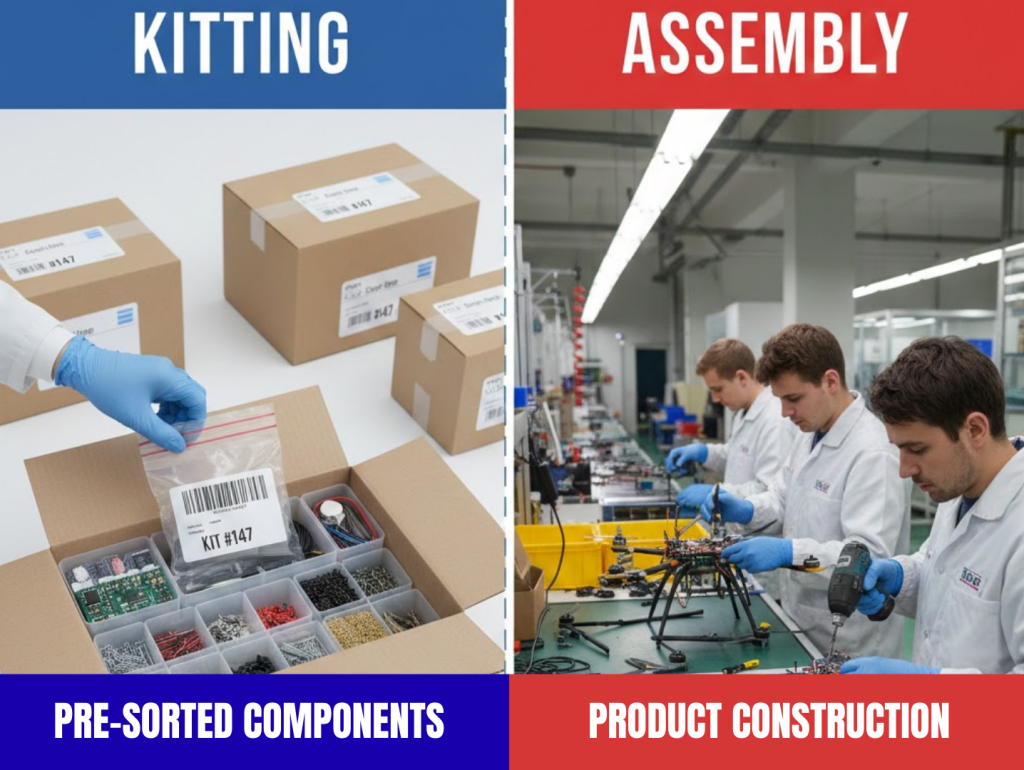
What Is the Difference Between Kitting and Assembly?
The difference between kitting and assembly comes down to organizing versus building. Kitting involves gathering multiple individual items, components, accessories, instructions, or promotional materials, and packaging them together as a single ready-to-ship unit without physically combining the items. Assembly involves physically putting parts together to create a finished or semi-finished product.
Kitting improves fulfillment efficiency by reducing picking and packing steps, while assembly focuses on construction, functionality, and quality control. Many businesses use both processes together, but understanding which one solves your specific problem is critical to scaling efficiently. Choosing the right approach allows packaging and kitting services to support growth rather than slow it down.
What Does “Assembly” Mean?
Assembly means physically constructing a product or component by joining multiple parts together. This may include light assembly, mechanical assembly, sub-assembly, or final assembly depending on the product. Assembly often requires trained labor, specialized tools, documented processes, and quality inspections.
Because of these requirements, assembly typically involves higher labor costs, greater liability, and stricter quality control than kitting. Businesses often outsource assembly when consistency, safety, or technical precision is essential. Assembly is common in electronics, medical devices, mechanical products, and consumer goods that must arrive ready for immediate use. For more insights, see What to Look for When Picking Fulfillment Services.
What Does Kitting Mean?
Kitting means grouping multiple individual items into a single packaged unit to simplify fulfillment, storage, and shipping. Items in a kit may include parts, manuals, promotional materials, accessories, or tools. Kitting reduces order processing time, minimizes picking errors, and creates a smoother customer experience.
Many companies turn to Ideal Fulfillment for kitting when order volume increases and internal teams struggle to keep up. It’s also common for businesses to request quotes when evaluating whether in-house kitting still makes sense versus outsourcing. According to the Council of Supply Chain Management Professionals, effective kitting improves order accuracy and reduces operational waste, one reason packaging and kitting services play such a critical role in modern fulfillment strategies.
When Kitting Is the Right Solution
Kitting is ideal when products don’t require physical construction but must be grouped consistently and accurately. Common use cases include onboarding kits, subscription boxes, promotional bundles, replacement part kits, training materials, and instruction-heavy products. Kitting shines when speed, flexibility, and scalability matter.
Because kitting reduces repetitive picking and packing tasks, it allows businesses to process higher order volumes without adding internal labor. For many companies, outsourcing packaging and kitting services frees internal teams to focus on sales, product development, and customer support instead of fulfillment bottlenecks.
When Assembly Makes More Sense
Assembly is the better option when products must arrive fully functional or require precise construction. This includes products with safety requirements, technical components, or regulatory standards, as well as scenarios where integrated packaging and kitting services help ensure all parts are correctly grouped and prepared. Assembly ensures consistency and reduces the risk of customer error during setup or use.
While assembly typically costs more upfront, it often saves money long-term by reducing returns, customer support issues, and warranty claims. Businesses that prioritize customer experience and reliability, especially those combining assembly with professional packaging and kitting services, often find assembly to be a worthwhile investment.
Using Packaging and Kitting Services Together
Many businesses don’t need to choose one or the other, they use both. Components may be assembled into sub-units and then kitted with accessories, manuals, or additional parts. This hybrid approach offers flexibility, efficiency, and scalability.
At Ideal Fulfillment, we frequently design workflows that combine assembly with packaging and kitting services, allowing companies to streamline operations without overwhelming internal teams. This approach is especially effective for growing businesses that need to scale quickly while maintaining accuracy.
Cost, Speed, and Scalability Considerations
Kitting is generally faster and less expensive than assembly, but it shifts some responsibility to the end user. Assembly increases labor costs but improves ease of use and customer satisfaction. Scalability also differs, kitting scales quickly with volume, while assembly may require additional staffing, training, and oversight.
Understanding these trade-offs helps businesses choose the right process based on margins, customer expectations, and long-term goals. Strategic packaging and kitting services allow companies to adapt as demand changes without constant operational restructuring.
How the Wrong Choice Impacts Fulfillment
Choosing the wrong process can create hidden costs. Over-assembling products that don’t need it ties up labor and slows fulfillment. Under-assembling products that require precision leads to returns and customer frustration. Kitting errors create missing components, while assembly errors create functional failures.
Clear process design, supported by experienced packaging and kitting services, reduces these risks and creates predictable, repeatable fulfillment outcomes.
Final Thought
Kitting and assembly aren’t competing services, they’re complementary tools that solve different operational challenges. The real value comes from understanding when to use each and how they fit into your broader fulfillment strategy. When chosen intentionally, both processes improve efficiency, accuracy, and customer satisfaction. Understanding the difference upfront saves time, money, and frustration as your business grows.
If you’re unsure whether kitting, assembly, or a combination of both is right for your operation, reach out to Ideal Fulfillment. Our team specializes in scalable packaging and kitting services designed to fit your workflow, not force you into one. Contact Ideal Fulfillment today for clear answers, practical guidance, and fulfillment solutions that grow with your business.
Follow our social media pages below: