 Ideal Fulfillment
As businesses scale, the decision to outsource warehousing and fulfillment shifts from “nice-to-have” to “we can’t keep doing this ourselves.” But before partnering with a 3PL, most brands want to understand one critical detail: What does it actually cost?
That’s where things get murky.
Every provider structures fees differently, and comparing one 3PL warehouse cost breakdown to another can feel like comparing apples to oranges. At Ideal Fulfillment, we’ve seen how confusing third-party logistics pricing can be for growing businesses especially when it’s not clear what’s included, what’s extra, and which fees actually move the needle.
This guide breaks down the real costs of 3PL warehousing so you can make confident decisions about your logistics strategy without getting blindsided by hidden charges or misleading “starting at” rates.
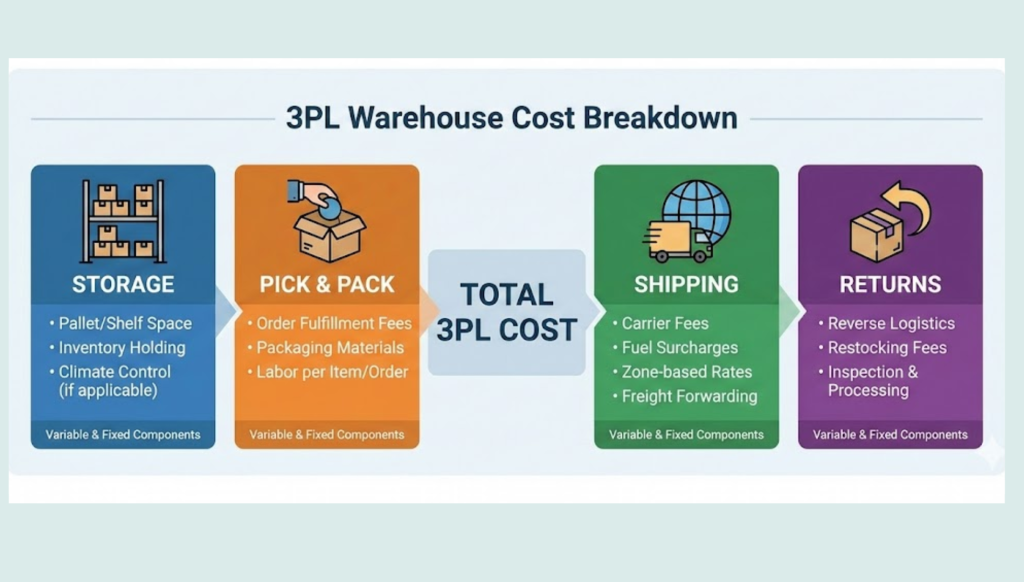
What Are the Costs Associated With Warehousing?
The true 3PL warehouse cost is made up of several pieces working together, not just a single “storage fee.”
Most 3PL warehouse pricing includes some or all of the following:
- Storage fees
Usually charged per pallet, bin, shelf, or cubic foot, and billed monthly. - Receiving fees
Cover unloading, inspecting, and checking in inbound inventory. - Pick-and-pack fees
Charged per order, per item, or per SKU picked and packed. - Packaging costs
Boxes, mailers, labels, tape, Dunnage, and any custom or branded packaging. - Shipping rates
Carrier charges based on weight, zone, service level, and dimensions. - Returns processing
Inspection, restocking, repackaging, or disposal of returned goods. - Inventory management & admin
Cycle counts, reporting, account management, and system access. - Special handling fees
For fragile items, hazardous materials, temperature control, or oversized products.
Your total 3PL warehouse cost will depend on:
- Order volume
- Number of SKUs
- Product size and weight
- Storage method
- Service level and complexity
Understanding these building blocks helps you compare providers more accurately and decide which 3PL warehouse cost structure fits your business best.
How Does Third-Party Logistics Reduce Costs?
It’s easy to focus on what a 3PL warehouse cost per month but the real question is: what would it cost you not to outsource?
Running your own warehouse means paying for:
- Lease or mortgage
- Racking and equipment
- Software and hardware
- Labor, benefits, and training
- Insurance and utilities
Using a 3PL rolls many of these into a predictable, usage-based 3PL warehouse cost, while often improving performance.
1. Shared Warehouse Space
Instead of renting an entire building, you share a facility with other brands and only pay for the space you actually use. This keeps your 3PL warehouse cost aligned with your current inventory level.
2. Reduced Labor Costs
Hiring, training, and managing a warehouse team is expensive and time-consuming. With a 3PL, labor is bundled into your pick, pack, and receiving fees which are tied to activity, not payroll.
3. Lower Packaging Costs
3PLs buy materials like boxes and mailers in bulk, lowering per-unit costs. That means packaging is often cheaper as part of your 3PL warehouse cost than it would be if you purchased it yourself.
4. Discounted Shipping Rates
Most 3PLs ship thousands of packages daily. That volume gives them access to better carrier discounts, which they can pass on to you. Even if your 3PL warehouse cost line items look detailed, your total landed cost per order often drops because shipping becomes more efficient.
5. Fewer Operational Headaches
You’re not juggling:
- Warehouse leases
- Equipment maintenance
- WMS and IT systems
- Worker’s comp and safety programs
Those responsibilities are built into your third-party logistics pricing instead of sitting on your plate.
6. Faster, More Accurate Shipping
Higher accuracy reduces returns, reships, and angry customer messages. Over time, that has a real impact on your bottom line and makes your 3PL warehouse cost easier to justify.
7. Scalability Without Heavy Investment
During slow seasons, your costs naturally shrink. During peak seasons, your 3PL scales up staff and space without you having to hire and train a temporary team or rent overflow space.
According to the Council of Supply Chain Management Professionals, logistics accounts for 8% of U.S. GDP, showing how costly inefficient operations can be.
Using a 3PL can dramatically reduce your logistics spend while improving customer satisfaction.
How to Calculate Storage Costs for a 3PL
Storage is often the most visible piece of your 3PL warehouse cost, and it’s usually charged in one of three ways:
- Pallet storage – Flat monthly fee per pallet position.
- Bin or shelf storage – For smaller items or brands with many SKUs.
- Cubic foot storage – When product dimensions vary widely.
Step 1: Determine Your Storage Type
Ask your provider how your products will be stored on pallets, in bins, or by cubic volume. The structure impacts how your 3PL warehouse cost scales as you grow.
Step 2: Multiply Quantity by the Provider’s Rate
Example:
If you store 10 pallets at $20 per pallet per month, your base storage cost is:
10 pallets × $20 = $200/month
Repeat this for bins or cubic feet if your inventory is split across storage types.
Step 3: Consider Long-Term Storage Fees
Many 3PLs charge extra for slow-moving or aged inventory. This piece of your 3PL warehouse cost is meant to encourage good inventory hygiene and turnover.
Step 4: Account for Seasonal Fluctuation
If you ramp up inventory before the holidays, your storage bill will follow. Reviewing the annual pattern of your 3PL warehouse cost helps you plan cash flow and purchasing strategies.
Step 5: Review Additional Storage-Related Charges
Potential add-ons include:
- Special handling
- Oversized item storage
- Hazardous materials storage
- Temperature-controlled or climate-sensitive products
If you want to see a real-world example of how 3PL warehouse cost is structured, you can review Ideal Fulfillment’s transparent pricing on our website.
What Type of Costs Are Associated With Public Warehousing?
Public warehousing where multiple businesses share a third-party facility, is the backbone of most 3PL models. The total 3PL warehouse cost for public warehousing typically includes:
- Storage Fees
Charged per pallet, bin, shelf, or cubic foot, billed monthly. - Receiving & Put-Away Fees
Unloading, inspecting, counting, and putting products into storage. - Pick & Pack Fees
Pricing per order, per unit, or per SKU picked and packed. - Packaging Fees
Standard or branded materials, mailers, labels, inserts, and Dunnage. - Shipping Costs
Carrier charges, often passed through with negotiated discounts. - Inventory Management Fees
Cycle counts, audits, stock rotation, or special reporting. - Returns Processing
Labor to inspect, sort, restock, or dispose of returned items. - Account or Service Fees
Monthly account management, onboarding fees, or project-based charges. - Special Handling Fees
For fragile, regulated, high-value, or custom-handled goods.
When you compare public warehousing options, you’re really comparing full 3PL warehouse cost structures not just a single rate.
Hidden Fees to Watch Out for in 3PL Contracts
Most reputable providers are upfront. Still, it’s smart to read the fine print so your 3PL warehouse cost doesn’t creep up unexpectedly.
Common “gotcha” fees can include:
- Pallet or carton disposal fees
- Same-day or rush receiving surcharges
- Inventory shrinkage allowances (a percentage of inventory “allowed” to disappear)
- IT integration or API access fees
- Minimum monthly spend or volume commitments
- Extra fees for manual orders or non-integrated channels
Always ask for a line-item breakdown of your projected 3PL warehouse cost and clarify what happens as your volume changes. For more insights, see How Smart Fulfillment Strategies Cut Down Shipping Time.
How 3PL Warehouse Location Impacts Cost
Location does more than affect transit times it also influences your 3PL warehouse cost in several ways:
- Shipping speed and zone-based pricing
Being closer to your customers can reduce carrier zones and per-package cost. - Inbound freight cost
Warehouses near ports or major hubs can lower container drayage and linehaul. - Carrier availability
High-volume regions often have more carrier options and better rates. - Labor availability and wage levels
Local labor costs impact the underlying third-party logistics pricing. - Facility costs and taxes
Different regions have different real estate and operating costs.
For example, a West Coast warehouse might reduce inbound freight from Asia but slightly increase outbound shipping to East Coast customers. Reviewing how location affects your 3PL warehouse cost across the whole supply chain is key.
Why Speed and Accuracy Reduce Long-Term Costs
It’s tempting to focus only on line items like storage and pick fees. But performance metrics also affect your true 3PL warehouse cost:
- Fewer errors mean fewer returns and reships.
- On-time shipments reduce customer service tickets and lost orders.
- Better packaging reduces damage and associated refunds.
- Faster shipping can improve conversion rates and repeat purchases.
In other words, a slightly higher per-order 3PL warehouse cost with excellent accuracy can be cheaper overall than a “bargain” provider that creates constant cleanup work.
When Your Business Should Consider Outsourcing Warehouse Operations
How do you know when it’s time to absorb a 3PL warehouse cost instead of DIY-ing everything?
You’re likely ready to outsource if:
- Your office, garage, or small warehouse is overrun with inventory
- You’re spending more time packing boxes than growing your brand
- Your error rate is climbing as order volume increases
- You need faster deliveries to stay competitive
- You’re expanding into new markets or sales channels
- Your products require special handling or storage conditions
At that point, a predictable 3PL warehouse cost is usually easier to manage than the hidden costs of in-house chaos: rushed hires, missed orders, storage limits, and burnout.
How to Compare 3PL Warehouse Cost Across Providers
When you start collecting quotes, you’ll notice that no two proposals look exactly alike. To compare 3PL warehouse cost structures fairly:
- Normalize by order volume
Ask what your total cost would be at your actual monthly order average. - Include shipping and packaging
Don’t just look at storage factor in shipping and packaging so you see your true per-order cost. - Ask for sample invoices
Real invoices (with sensitive data redacted) show how fees appear in practice. - Check minimums and commitments
Make sure minimums or tier thresholds won’t inflate your 3PL warehouse cost if your sales fluctuate. - Weigh value, not just price
Consider technology, support, reporting, and accuracy. The cheapest quote isn’t always the smartest choice.
Final Thought
Understanding the true cost of 3PL warehousing goes far beyond a single storage rate. When you break down 3PL warehouse cost into storage, receiving, pick-and-pack, packaging, shipping, returns, and value-added services, you get a much clearer picture of what you’re really paying for and what you’re getting in return.
A reliable 3PL doesn’t just store your products. The right partner streamlines your operations, reduces overhead, and gives you the flexibility to scale with confidence.
Want to see how 3PL pricing works in real numbers not just theory? Explore our transparent 3PL warehouse cost details or connect with the team at Ideal Fulfillment to talk through your products, volume, and goals. We’ll help you understand your options so you can choose a warehousing solution that truly supports your next stage of growth.
Follow our social media pages below: